


Women’s History Month is designed to look backward, excavating lost heroines, honoring what women have overcome, documenting what they've achieved, and measuring progress often against a male standard. While I personally have always had a love/hate relationship with this short lived spotlight, this year I have been stunned to learn that 99% of recorded history has focused on men…and sobered to reflect on the increasing dangers and inequities women around the world face, from Kabul, Afghanistan to Lubbock, Texas.
But today is March 31st, and time to look forward; to find inspiration not only by the accomplishments in the rearview mirror, but by the ones becoming possible right now.
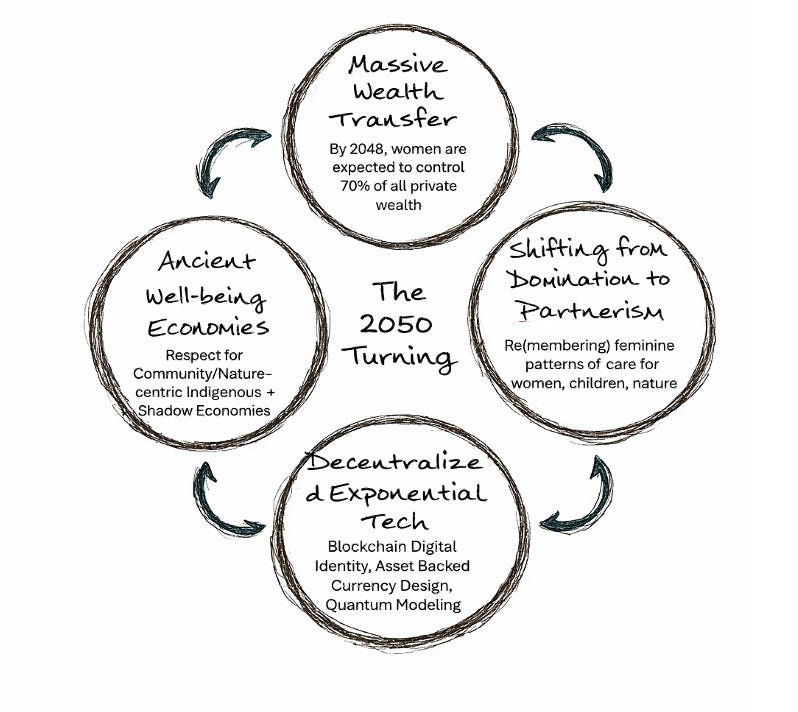
At a time of tremendous change, uncertainty, and systemic vulnerability, four tectonic shifts are converging to open the door to an entirely new story…one we maybe someday will be described as “the turning”?
The largest transfer of wealth in human history flowing toward people (women in particular) who have a different relationship to power.
A recognition of ancient, proven, cooperative structures — long dismissed as "informal", these that are now able to expand more broadly
The advance of exponential technologies that can do for trust, transparency and collective coordination what the printing press did for the spread of ideas.
A re-membering of the Partnership structures and feminine codes that have long nurtured community, family, nature and societal wellbeing
Separately, each of these big shifts are newsworthy. Together, they form a stunning new story of how we can now build inclusive systems, cooperative agreements, caring economic and political movements that support regenerative/relational living systems.
Note: This is an overview of a (very) long piece I’ve written that includes all the source links and corroborating data. If you’d like a copy of this, just let me know.
Let’s start with the money.
By 2048, an estimated $124 trillion in private wealth will transfer hands in the United States alone — the largest movement of capital in human history. Globally, women already control $60 trillion in assets. Bank of America estimates that 70% of the US transfer will ultimately flow to women. Within a single generation, women could control close to two-thirds of all private wealth in the United States. And this phenomena is happening around the globe (though to varying degrees).
But this is not a financial story. It is a civilizational one, because the women receiving this wealth are not simply stepping into existing systems. They are arriving with different experiences, different constraints, and measurably, a fundamentally different set of assumptions about what wealth is for. And contrary to popular belief, women are quite competent managing their money…their way.
The data shows:
Women outperform male investors by nearly two percentage points annually patience and long-term thinking.
Women invest in ESG factors at twice the rate of men.
Among ultra-high-net-worth individuals, 60% of women cite philanthropy as their primary interest — the only majority among any category surveyed — compared to 35% of men.
Women often direct investments and philanthropy to supporting women, girls and nature; when Melinda Gates left the foundation she co-founded, she shifted gears and dollars to focus on women and girls, noting that barely 1.9% of philanthropic funding is focused specifically on their needs.
Women tend to think of themselves as custodians or stewards of wealth and are committed to giving their fortunes away as quickly as they can. MacKenzie Scott, for example, has given away more than $19 billion since 2019 with no foundation infrastructure, no naming rights, and no strings attached, and Marlene Engelhorn who gave 90% of her inherited fortune to a citizens' council of randomly selected strangers, saying plainly that she never earned it and therefore never truly owned it.
Women consider “what is enough” and are active proponents, such heiress Abigail Disney and leader of “Patriotic Millionaires” Erica Payne advocating for rebalancing the tax system and questioning the need for billionaires at all.
This is not a confidence gap, as the financial industry has long insisted. It is a values gap. And it opens one of the most significant opportunities — and responsibilities — of our time.

While the largest transfer of private wealth in human history begins flowing toward people with a fundamentally different relationship to what wealth is for, ancient cooperative structures and “shadow economies” born out of exclusion from formal banking and financial structures are showing their resilience and sustainability. Dismissed as informal, they are now gaining both respect and access to tools capable of scaling them globally. Across cultures and geographies these systems take different names—Susu in the Caribbean, Tanda in Mexico, Ajo in Nigeria, Ekub in Ethiopia—but they share a common structure. Often referred to as ROSCAs (Rotating Savings and Credit Associations), they operate on a principle of mutual contribution: a group pools resources, and each member receives access to that capital in turn. No collateral. No credit scoring. No institutional intermediary with taxing fees.
Exponential technologies are beginning to do for trust and this kind of collective coordination what the printing press had done for ideas. Identity is becoming portable and verifiable. Coordination costs are collapsing as emerging coordination technologies (eg. blockchains) reduce the need for formal, banking intermediaries allowing trust-based systems and local/bioregional asset backed currencies to expand without defaulting to extraction-based offerings. Collective decision-making and governance options are emerging. And soon quantum modeling will let us see the whole problem…and potential solutions. Even the physical infrastructure/energy stack necessary can be can now decentralized to ensure access to all; distributed renewable energy — solar microgrids, community-owned wind, peer-to-peer energy trading — is the physical-layer equivalent of the distributed, peer to peer web. When a village in Rwanda owns its solar microgrid, it controls an asset, generates revenue, and breaks dependence on centralized infrastructure.
While frontier technologies open new possibilities, they are accompanied by a deep re-membering of the wisdom traditions, the feminine codes, the heroine's journey that had been oppressed thousands of years, ensuring this will be created and distributed fairly and justly. A growing awakening is pushing away from systems of centralized control, hierarchy and domination (over people and nature) to a more just model of mutual benefit that kept ancient civilizations thriving.
Separately, each of these big shifts are newsworthy. Together, they form a stunning new story of how we can now build inclusive systems, cooperative agreements, caring economic and political movements that support regenerative/relational living systems.
And this can’t happen fast enough, as this is all transpiring within the context of a polycrisis: interwoven concerns about planetary health and stability, alarming wealth inequality and polarizing political rhetoric, economic fears and significant job dislocation in the face of AI, robotics and an explosion of new technological breakthroughs, increasing global tensions and violence… all somehow also fueling a horrifying backlash against women, girls and minority voices overall – from government leaders, “influencers” and peers. It feels so encouraging to see a path out.
So, How Did We Get Here?
To imagine how radically things can really change, it’s worth backing up to consider how things have been set up as they are, and how the frameworks currently organizing our world were very deliberately designed in key moments of agreement that did not include most of the people living in it:
They were not designed for/with women
They were not designed for/with the majority world
They were not designed for/with the intelligence of the living systems that sustain all human life
The structures guiding our entire socio-economic lives were very intentionally architected by a remarkably small and homogenous group for a planet with fewer than two billion people before the ecological consequences of infinite-growth logic were understood, and at a moment in history when the vast majority of humanity had no voice, no vote, and no seat at any of the tables where the rules were written. This happened as women were denied education, property ownership rights, as well as access to employment, banking, credit and fair pay until just the last century…with many around the world still locked out.
It happened and around a table in Berlin in 1884, where fourteen European nations divided the entire continent of Africa without inviting a single African voice.
It happened at Bretton Woods in 1944, where the rules of global finance were written without the majority world or women in the room; and in every economics classroom since, where growth was assumed to be always good, nature always a resource, and care always a cost.
These were not natural laws. They were design choices based on the foundation of domination over people and nature. And like all designs built on incomplete input and incorrect assumptions, they are reaching the end of their useful life — ecologically, economically, politically, and technologically, all at once.
What replaces them is already under construction…and it is looking great!
The Turning From Here to Next
The answer is not emerging from a single theory or institution. But a body of work—developed over decades by women and men from all corners of the world—that provides scaffolding to the transitions emerging.
Among the most influential is the power scale developed by Austrian-born American systems scientist, legal scholar and author, Riane Eisler, who writes about the effect of gender and family politics historically on societies and distinguishes between two fundamental ways of organizing human societies: Domination vs Partnership Systems.

Encouragingly, this is ancient news as archaeological and anthropological research suggests that for much of human history, partnership-oriented systems were the norm rather than the exception—organized around cooperation, caregiving, and long-term stability. The shift toward domination occurred maybe just 6000 years ago — a drop in the evolutionary bucket.
The Builders Already at Work
It would be a mistake to read this as a story of collapse awaiting rescue. Many have been and are working quietly, unevenly, and often outside the center of attention. What distinguishes these efforts is not that they share a single ideology or structure; it is that they reflect a different set of assumptions about what economic systems are for:
Policy:
In Mexico, Claudia Sheinbaum has launched a national care system and reduced women's retirement age in formal recognition of unpaid labor — proving that care-centered policy is not utopian. It is popular. Iceland has topped the World Economic Forum's Gender Gap Index for fourteen consecutive years — not because of one leader, but because gender equality has been built into the architecture of the state itself. In Rwanda, women hold 64% of parliamentary seats — the highest proportion in the world — and have used that presence to reshape inheritance law, land rights, and protections against gender-based violence (even without receiving full rights themselves).
Economics:
A new generation of economists is formalizing the shift: Mariana Mazzucato reframes the state as a co-creator of value. Kate Raworth's Doughnut Economics places human well-being and planetary limits at the center of economic activity. Christine Lagarde — the first woman to lead both the IMF and the European Central Bank — has spent fifteen years making the case in the language finance ministers actually hear: economies that exclude women are structurally weaker than they need to be.
Institutional Infrastructure:
At the energy scale, Dr. Angela Wilkinson — the first woman Secretary General of the World Energy Council argues that faster, fairer energy transitions require not just new technology but new collective wisdom; that the communities most excluded from the old energy system are often closest to the knowledge the new one needs.
AI and Exponential Technology:
As the race toward Artificial General Intelligence accelerates, women around the world are asking the question drowned out by the noise: what happens when we choose to infuse the capacities that make us human rather than race to build a civilization that replaces them?
Nora Bateson (Bateson Institute) coined the term Warm Data to name what algorithmic intelligence is structurally unable to see: the transcontextual, relational intelligence that lives not in isolated data points but in the living patterns between them. Isabelle Hau (Stanford) argues the next frontier of human development is “Relational Intelligence” the capacity to build trust, navigate difference, repair ruptures, and create meaning together and asking how we design AI for human flourishing? Abi Awomosu, a former insider at Apple, Microsoft, Uber, and Meta, left Big Tech with a fundamentally different theory and architecture of what intelligence is: “relational, emergent and reciprocal rather than computational and extractive” And Timnit Gebru, (founder of DAIR) the Eritrean-Ethiopian computer scientist fired from Google in 2020 for co-authoring a paper warning of the dangers of large language models, continues asking who is building it, for whom, and whose futures it is designed to serve?
Culture and Storytelling:
The stories we tell shape what we believe, see and create. Science fiction legend Ursula Le Guin challenged patterns of, using her decades of writing to imagine worlds where control was not destiny. Shonda Rhimes reshaped mainstream storytelling by centering lives long treated as peripheral. And in record time, K-Pop Demon Hunters has become Netflix's most-watched film ever by following the arc of the “Heroine’s Journey” (which psychotherapist Maureen Murdock pointed out is distinctly different than the Hero’s) by making peace with shadow, working collectively, and healing rather than conquering.
Community Building:
Similarly, beyond mainstream media, women of all ages are gathering in circles, retreats, and intimate conversations (even at global scale) to share their own stories and reclaim wisdom traditions that value intuition, nature's rhythms, collective care, and mutual benefit. They are forming networks of protection and aid; they are marching in peace.
Matriarchy, as these conversations rediscover, is not about replacing men at the top of a hierarchy; it is about making rigid hierarchy obsolete.
Importantly, as the economic and influence table widens, men also have the freedom to rewrite their stories: as nature's protectors rather than conquerors, as emotionally present fathers and, as fully supported partners.
Cultivating a world that works for everyone begins with healthy, inclusive stories because every structural transformation in history has been preceded by a transformation in narrative.
A Peek Into our Futures: What if…?
Now this is the part of the work that excites me most! In the world of exponential possibility, things can turn faster than we expect and usually in ways we couldn't have predicted from inside the moment before. While data shows right now we can only imagine this all going wrong, what the confluence of these forces actually points to is all that could go right.
Firing up our imaginations, we can start to see ways this all takes tangible form just the next 25 years in ways that will be remembered and celebrated as the (re)turning point back to the patterns of mutual thriving that held us well… but in a whole new form.
What if…
By 2029, the people who actually feed the world — Indigenous land stewards and women-led farming cooperatives representing 340 million farmers across 67 countries — sign the Regenerative Agriculture Compact without waiting for government consensus. No conference center. No single stage. Signed simultaneously in five places where the food actually grows: the Amazon basin, the Sahel, the Mekong Delta, the Punjab, and Iowa--the heart of the industrial corn belt, where the old model was born and where its replacement will be chosen.
By 2031, women in the US will control an estimated 58% of all investable assets. That same year, the first Global Women's Wealth Summit will convene simultaneously in Nairobi, Mumbai, São Paulo and Detroit. The Upstream Compact born there will shift global philanthropy from measuring outputs to measuring whether giving actually changes who falls in the river.
By 2033, the highest-grossing film in history will be produced between studios in Lagos, Nairobi and Seoul, financed by women-led funds, and depicting Earth in 2100 as a world that worked very hard and got most of it right. People will want to live in the world it describes and create millions of fractal stories to extend it.
By 2035, the first Global Reconciliation Week will be held in the week before the Spring Equinox — drawing on Rwanda's Gacaca tradition of community truth-telling, the moral accounting of Yom Kippur, and indigenous seasonal reckoning ceremonies from six continents. Communities will gather to name and grieve the specific harms of specific histories…and then celebrate in forgiveness together. The communities that participate will consistently report stronger social trust, higher civic participation, and in a finding that will surprise the researchers who first document it: significantly higher long-term investment in shared infrastructure. Reconciliation, it will turn out, is not a cost. It is a precondition.
And by 2050, on the Spring Equinox— what we used to call International Women's Day, now simply called The Gathering — four thousand simultaneous circles will meet outside, on every continent, to celebrate their interdependence with each other and with the living world. In a clearing in British Columbia's Great Bear Rainforest, a young Kwiakah-Métis woman named Coho will facilitate her circle as a hologram activates between the trees — weaving together collective memory, elder voices, data, and ceremony — to show her generation how they got there.
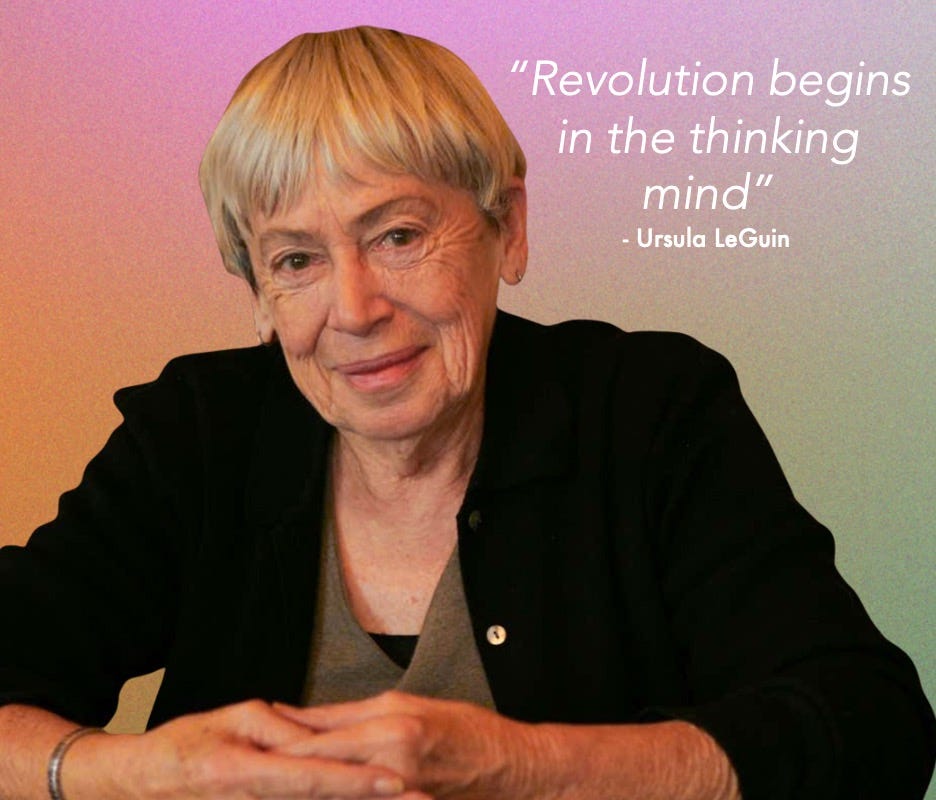
Ursula Le Guin reminded us that “The revolution begins in the thinking mind”. And the forces are gathering to mobilize these new and ancient thoughts. The money is moving. The tools exist. The ancient cooperative structures are proven. The stories are changing. Hope is a very legitimate stance to take.
What becomes possible when the people with the most intentional relationship to wealth finally get enough of it to find out? We are about to learn.
Let the turning begin. 💜🌿